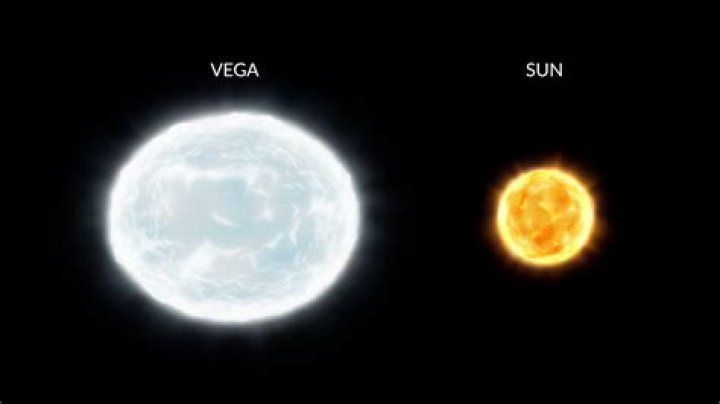
Vega, one of the brightest stars in the night sky, has fascinated astronomers and stargazers for centuries. This brilliant blue-white star is a symbol of beauty and mystery in the universe. Located in the constellation Lyra, Vega holds a special place in both scientific research and cultural mythology.
From ancient civilizations to modern astronomy, Vega has been a beacon of knowledge and wonder. The star's luminosity and proximity to Earth make it a critical reference point for scientists studying the cosmos. Its name, derived from Arabic, means "the falling eagle," reflecting its historical significance across cultures.
As we delve deeper into the world of Vega, this article will explore its properties, historical importance, scientific discoveries, and cultural impact. Whether you're a seasoned astronomer or a curious beginner, this comprehensive guide will illuminate the fascinating aspects of this celestial gem.
Introduction to Vega
Vega is one of the most prominent stars in the northern hemisphere's night sky. It belongs to the constellation Lyra and is part of the Summer Triangle, a well-known asterism visible during the summer months. The star's brightness and distinct color make it easily recognizable even to amateur stargazers.
Scientifically, Vega is classified as an A-type main-sequence star, meaning it is in the prime of its life cycle, fusing hydrogen into helium. Its luminosity and temperature place it among the most studied stars in astronomy, providing valuable insights into stellar evolution and the structure of the universe.
Why Study Vega?
The importance of studying Vega lies in its proximity and brightness, which allow scientists to gather detailed data about its properties. This data helps refine models of stellar physics and contributes to our understanding of the cosmos. Additionally, Vega's disk of dust and debris offers clues about planetary system formation.
Where is Vega Located?
Vega resides in the constellation Lyra, which is named after the lyre, a musical instrument associated with the Greek mythological figure Orpheus. The star is approximately 25 light-years away from Earth, making it one of the closest stars to our solar system. Its position in the sky makes it visible from most parts of the world at different times of the year.
Visibility of Vega
- Best viewed during the summer months in the northern hemisphere.
- Can be seen year-round from latitudes above 51 degrees north.
- Appears high in the sky during the summer evenings.
Key Properties of Vega
Vega's unique characteristics set it apart from other stars in the night sky. With a surface temperature of around 9,600 Kelvin and a luminosity approximately 40 times that of the Sun, Vega shines brightly in our night sky. Its rapid rotation causes it to flatten at the poles, a phenomenon known as oblateness.
Below are some key properties of Vega:
- Spectral Type: A0V
- Mass: 2.1 times that of the Sun
- Radius: 2.36 times that of the Sun
- Age: Approximately 455 million years
Impact of Vega's Properties
These properties not only make Vega an interesting subject for study but also provide valuable data for understanding the lifecycle of stars. The star's young age and high mass suggest it will burn brightly for a relatively short time before evolving into a white dwarf.
Historical Significance of Vega
Vega has been a significant star in various cultures throughout history. In ancient Egypt, it was associated with the goddess Ma'at, representing truth and order. The Chinese called it the "Weaving Maid Star" and linked it to a romantic myth involving the separation of two lovers by the Milky Way.
In modern times, Vega played a crucial role in the development of astronomy. It was one of the first stars to be photographed and served as a reference point for calibrating the brightness of other stars. Its historical importance continues to inspire both scientists and storytellers alike.
Key Historical Milestones
- 1850: Vega became the first star (other than the Sun) to be photographed.
- 1930s: Used as a zero point for the stellar magnitude scale.
- 20th Century: Played a role in the discovery of interstellar dust.
Scientific Discoveries Related to Vega
The study of Vega has led to numerous groundbreaking discoveries in astronomy. One of the most significant findings was the detection of a disk of dust surrounding the star, suggesting the presence of a planetary system. This discovery provided valuable insights into the process of planet formation and evolution.
Additionally, Vega's rapid rotation and oblateness have helped scientists refine models of stellar dynamics and structure. These discoveries continue to shape our understanding of the universe and inspire further research.
Key Scientific Contributions
- Discovery of a circumstellar disk of dust.
- Insights into stellar rotation and oblateness.
- Calibration of stellar magnitude scales.
Cultural Mythology Surrounding Vega
Across cultures, Vega has been woven into myths and legends, symbolizing everything from love and beauty to wisdom and order. In Greek mythology, it was associated with Orpheus, the legendary musician whose lyre was placed in the sky as the constellation Lyra.
In Chinese folklore, Vega is part of the romantic tale of the "Herd Boy and the Weaving Maid," where the star represents the weaving maid separated from her lover by the Milky Way. This myth is celebrated annually during the Qixi Festival, a Chinese equivalent of Valentine's Day.
Mythological Themes
- Love and separation in Chinese mythology.
- Music and art in Greek mythology.
- Order and truth in Egyptian mythology.
Comparison with Other Stars
While Vega is one of the brightest stars in the night sky, it is not the only one with fascinating properties. Comparing it to other stars like Sirius, Betelgeuse, and Alpha Centauri highlights its unique characteristics and contributions to astronomy.
Sirius, for example, is the brightest star in the sky, but Vega's blue-white color and rapid rotation make it stand out. Betelgeuse, a red supergiant, is much larger and cooler than Vega, illustrating the diversity of stellar types in the universe.
Comparison Chart
| Star | Spectral Type | Distance (light-years) | Luminosity (Sun=1) |
|---|---|---|---|
| Vega | A0V | 25 | 40 |
| Sirius | A1V | 8.6 | 25 |
| Betelgeuse | M2Iab | 642 | 120,000 |
Current Research on Vega
Ongoing research on Vega focuses on understanding its circumstellar disk, rotation dynamics, and potential planetary system. Advanced telescopes and instruments, such as the Hubble Space Telescope and the Atacama Large Millimeter/submillimeter Array (ALMA), are providing new insights into these areas.
Scientists are particularly interested in the disk of dust surrounding Vega, as it may contain clues about the formation of planets. Studying this disk could help answer fundamental questions about how planetary systems evolve over time.
Research Tools and Techniques
- Hubble Space Telescope for high-resolution imaging.
- ALMA for studying the disk's composition and structure.
- Computer simulations to model stellar dynamics.
Future Prospects in Studying Vega
As technology continues to advance, the study of Vega will undoubtedly reveal even more secrets about this fascinating star. Future missions and telescopes, such as the James Webb Space Telescope and the Extremely Large Telescope, promise to provide unprecedented views of Vega and its surroundings.
These advancements could lead to breakthroughs in our understanding of stellar evolution, planetary system formation, and the structure of the universe. Vega's proximity and brightness make it an ideal target for these ambitious projects.
Upcoming Missions
- James Webb Space Telescope: To study the composition of Vega's disk.
- Extremely Large Telescope: For high-resolution imaging and spectroscopy.
- Future space missions: To explore the potential for exoplanets around Vega.
Conclusion and Call to Action
Vega, with its brilliant light and intriguing properties, continues to captivate scientists and stargazers alike. From its historical significance to its role in modern astronomy, this star has much to offer in terms of knowledge and inspiration. By studying Vega, we gain valuable insights into the workings of the universe and our place within it.
We invite you to join the conversation by leaving a comment, sharing this article, or exploring other topics on our website. Together, we can continue to unravel the mysteries of the cosmos and appreciate the beauty of stars like Vega.




