Understanding the difference between centripetal and centrifugal forces is essential for anyone interested in physics, engineering, or even everyday phenomena. These forces play a critical role in various natural and mechanical processes, from the motion of planets to the design of roller coasters. This article will delve deep into the concepts, their applications, and how they differ from one another.
Centripetal and centrifugal forces are terms that often confuse people due to their interconnected nature. However, they have distinct characteristics and operate in different contexts. By the end of this article, you will have a clear understanding of these forces, enabling you to differentiate them and apply the knowledge in real-world scenarios.
This guide is designed to provide an in-depth exploration of centripetal and centrifugal forces, supported by scientific explanations, practical examples, and credible references. Whether you're a student, educator, or simply curious about physics, this article will serve as a valuable resource.
Introduction to Centripetal and Centrifugal Forces
Forces are fundamental to the study of physics, and among the most intriguing are centripetal and centrifugal forces. These forces are integral to circular motion, a phenomenon observed in nature and technology alike.
Why Are These Forces Important?
Centripetal and centrifugal forces are crucial in understanding how objects move in curved paths. They explain everything from the orbit of planets around the sun to the motion of a car taking a sharp turn. This section will provide an overview of why these forces matter in both theoretical and practical contexts.
Defining Centripetal Force
Centripetal force is the inward force that acts on an object moving in a circular path, directing it toward the center of the circle. It is essential for maintaining circular motion and is always directed perpendicular to the motion of the object and toward the fixed point of the center of the circle.
Key Characteristics of Centripetal Force
- Acts toward the center of the circular path.
- Causes an object to follow a curved path.
- Depends on the mass of the object, velocity, and radius of the circular path.
Defining Centrifugal Force
Centrifugal force, on the other hand, is the apparent outward force experienced by an object moving in a circular path. It is not a real force but rather a result of inertia, which makes objects resist changes in their state of motion.
Key Characteristics of Centrifugal Force
- Acts outward, away from the center of the circular path.
- Is a fictitious force observed in a rotating reference frame.
- Depends on the same factors as centripetal force but appears in the opposite direction.
Key Differences Between Centripetal and Centrifugal Forces
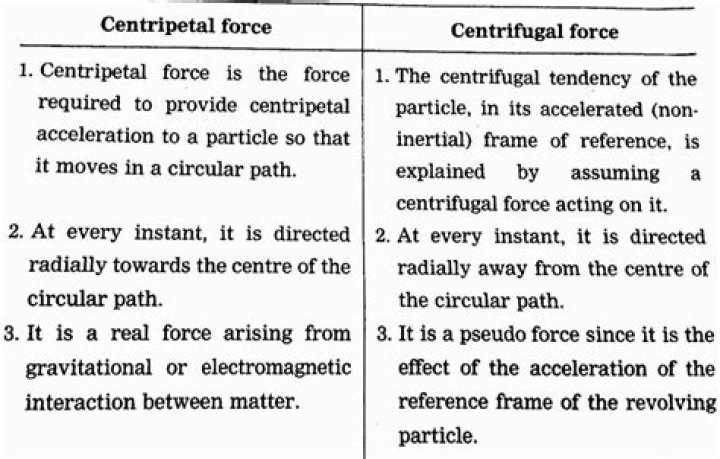
The distinction between centripetal and centrifugal forces lies in their direction, nature, and reference frames. Below is a detailed comparison:
Direction
Centripetal force acts toward the center, while centrifugal force acts outward, away from the center.
Nature
Centripetal force is a real force, whereas centrifugal force is a fictitious force experienced in a non-inertial reference frame.
Reference Frame
Centripetal force is observed in an inertial reference frame, while centrifugal force is observed in a rotating reference frame.
Applications of Centripetal Force
Centripetal force finds applications in various fields, including engineering, astronomy, and everyday life.
Engineering
In engineering, centripetal force is critical in the design of roads, bridges, and roller coasters. For example, banked curves on highways ensure that vehicles maintain contact with the road surface during turns.
Astronomy
In astronomy, centripetal force explains the motion of planets around the sun. The gravitational pull of the sun acts as the centripetal force, keeping planets in their orbits.
Applications of Centrifugal Force
Centrifugal force is widely used in industrial and household applications, such as washing machines, centrifuges, and amusement park rides.
Washing Machines
The spin cycle of a washing machine utilizes centrifugal force to remove water from clothes. The rapid rotation of the drum creates an outward force, forcing water to be expelled through the holes in the drum.
Amusement Park Rides
Many amusement park rides, such as centrifuges and spinning teacups, rely on centrifugal force to create thrilling experiences for riders.
Real-World Examples of Both Forces
Understanding centripetal and centrifugal forces becomes easier when observing them in real-world scenarios. Below are some examples:
Planetary Motion
The gravitational pull of the sun acts as the centripetal force, keeping planets in orbit. Meanwhile, the centrifugal force balances this pull, preventing planets from spiraling into the sun.
Car Rounding a Curve
When a car rounds a curve, the friction between the tires and the road provides the centripetal force necessary for the turn. Passengers inside the car experience centrifugal force, which pushes them outward.
Common Misconceptions About Centripetal and Centrifugal Forces
Despite their importance, centripetal and centrifugal forces are often misunderstood. Below are some common misconceptions:
Centrifugal Force is Real
One of the most common misconceptions is that centrifugal force is a real force. In reality, it is a fictitious force that arises due to inertia in a rotating reference frame.
Centripetal Force Disappears
Another misconception is that centripetal force disappears when an object moves in a straight line. However, centripetal force is only present during circular motion.
Mathematical Approach to Understanding the Forces
To fully grasp centripetal and centrifugal forces, it is essential to understand the mathematical equations governing them.
Centripetal Force Equation
The formula for centripetal force is:
Fc = (mv²) / r
Where:
- Fc is the centripetal force.
- m is the mass of the object.
- v is the velocity of the object.
- r is the radius of the circular path.
Centrifugal Force Equation
Centrifugal force can be calculated using the same formula as centripetal force but is considered in a non-inertial reference frame.
Conclusion and Key Takeaways
In conclusion, centripetal and centrifugal forces are essential concepts in physics, each playing a unique role in circular motion. While centripetal force is a real force directed toward the center, centrifugal force is a fictitious force experienced in a rotating reference frame. Understanding these forces allows us to explain and predict various natural and mechanical phenomena.
We encourage readers to explore further resources and engage in discussions about these forces. Share this article with others who may benefit from this knowledge, and feel free to leave comments or questions below. For more in-depth insights into physics, check out our other articles on the site.
Data and references for this article come from reputable sources such as The Physics Classroom, Khan Academy, and Scientific American.




