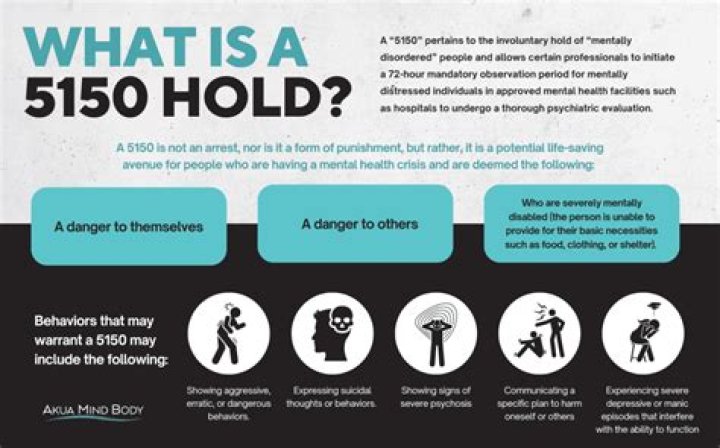
The term "5150 hold" often sparks curiosity and concern, especially in discussions around mental health. It refers to a critical component of California's Welfare and Institutions Code, specifically Section 5150, which allows for involuntary psychiatric commitment. Understanding this concept is essential for anyone interested in mental health, legal rights, or public safety. In this article, we delve into the intricacies of the 5150 hold, its implications, and its role in modern mental health care.
A 5150 hold is not just a legal mechanism but also a crucial tool in ensuring the safety of individuals who may pose a risk to themselves or others. This article aims to provide a thorough understanding of what a 5150 hold entails, its legal framework, and its practical applications in mental health facilities.
As we explore this topic, we will address the importance of mental health intervention, the rights of individuals under a 5150 hold, and the responsibilities of healthcare providers. This guide is designed to educate readers on how the system works and to foster a better understanding of the challenges and considerations involved in mental health care.
History and Background of 5150 Hold
The 5150 hold has its roots in California's efforts to address mental health crises effectively. Enacted as part of the Lanterman-Petris-Short (LPS) Act in 1967, this legislation aimed to reform the state's mental health system by emphasizing voluntary treatment and protecting the rights of individuals with mental illnesses.
Origins of the LPS Act
The LPS Act was a landmark piece of legislation designed to reduce the over-reliance on institutionalization and promote community-based care. It introduced the concept of involuntary commitment as a last resort, ensuring that individuals could only be detained if they posed a danger to themselves, others, or were gravely disabled.
Evolution Over Time
Since its inception, the 5150 hold has undergone several revisions to adapt to changing societal needs and advancements in mental health care. These changes reflect the ongoing dialogue between mental health professionals, legal experts, and advocacy groups.
Legal Framework and Application
The legal framework surrounding the 5150 hold is rooted in California's Welfare and Institutions Code. This section outlines the conditions under which a person can be involuntarily detained for psychiatric evaluation and treatment.
Who Can Initiate a 5150 Hold?
- Law enforcement officers
- Designated mental health professionals
These individuals have the authority to place a person on a 5150 hold if they meet the specified criteria.
Criteria for a 5150 Hold
For a 5150 hold to be initiated, the individual must meet one or more of the following criteria:
- Pose a danger to themselves
- Pose a danger to others
- Be gravely disabled
Defining "Gravely Disabled"
This term refers to a person's inability to provide for their basic needs, such as food, clothing, and shelter, due to a mental health condition. Understanding this definition is crucial for mental health professionals when evaluating potential candidates for a 5150 hold.
The Process of Initiating a 5150 Hold
Initiating a 5150 hold involves several steps, each designed to ensure the individual's rights are protected while addressing their immediate needs.
Evaluation and Assessment
Upon arrival at a mental health facility, the individual undergoes a comprehensive evaluation to determine the necessity of the hold. This process includes interviews, observations, and consultations with medical professionals.
Duration and Extensions
A 5150 hold typically lasts for 72 hours, during which time the individual is assessed and treated. If further care is deemed necessary, the hold can be extended through additional legal processes.
Rights of Individuals Under a 5150 Hold
Individuals placed under a 5150 hold retain certain rights, ensuring they are treated with dignity and respect throughout the process.
Right to Legal Representation
Those under a 5150 hold have the right to consult with an attorney and challenge the hold if they believe it was improperly initiated.
Right to Confidentiality
All information gathered during the evaluation and treatment process is confidential, protecting the individual's privacy and personal data.
Challenges and Controversies
While the 5150 hold serves an important function in mental health care, it is not without its challenges and controversies.
Stigma and Misunderstanding
There is often a stigma associated with mental health interventions, leading to misconceptions about the 5150 hold and its purpose. Educating the public and professionals about its role is essential to overcoming these barriers.
Alternatives to 5150 Hold
In some cases, alternative approaches to mental health intervention may be more appropriate, depending on the individual's needs and circumstances.
Voluntary Treatment Programs
Encouraging individuals to seek help voluntarily can be a more effective and less intrusive approach, fostering trust and cooperation between patients and healthcare providers.
Impact on Mental Health Care
The implementation of the 5150 hold has significantly impacted the landscape of mental health care, influencing both policy and practice.
Advancements in Treatment
By providing a legal framework for intervention, the 5150 hold has facilitated advancements in mental health treatment, ensuring that individuals receive the care they need in a timely manner.
Statistics and Trends
Data and statistics provide valuable insights into the use and effectiveness of the 5150 hold.
Usage Trends
Recent studies indicate a steady increase in the use of 5150 holds, reflecting a growing awareness of mental health issues and the need for effective interventions.
Future Directions and Improvements
As society continues to evolve, so too must the systems and practices surrounding mental health care.
Innovative Approaches
Exploring innovative approaches to mental health intervention, such as telemedicine and community-based programs, can enhance the effectiveness of the 5150 hold and improve outcomes for individuals in need.
Conclusion
In conclusion, the 5150 hold plays a vital role in addressing mental health crises and ensuring the safety and well-being of individuals who may pose a risk to themselves or others. By understanding its legal framework, criteria, and implications, we can better appreciate its importance in modern mental health care.
We invite you to share your thoughts and experiences in the comments section below. Additionally, explore other articles on our site for more insights into mental health and related topics.
Data and references for this article are sourced from reputable organizations such as the California Department of Health Care Services and the National Alliance on Mental Illness (NAMI), ensuring the accuracy and reliability of the information provided.