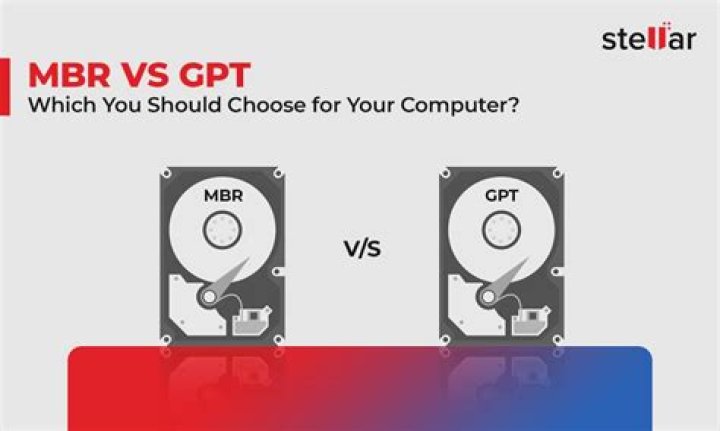
When it comes to managing storage devices, understanding the differences between MBR (Master Boot Record) and GPT (GUID Partition Table) is crucial for ensuring optimal performance and reliability. Both partitioning schemes have their own unique advantages and limitations, making it essential to choose the right one for your specific needs. In this article, we will explore the intricacies of MBR and GPT, helping you make an informed decision.
As technology advances, the need for efficient and secure data storage solutions becomes increasingly important. MBR and GPT are two of the most popular partitioning schemes available today, each with distinct features that cater to different requirements. Whether you're setting up a new system or upgrading an existing one, knowing the differences between these two options can significantly impact your storage experience.
By delving into the technical aspects of MBR disk vs GPT, we aim to provide you with a comprehensive understanding of their capabilities, compatibility, and limitations. This knowledge will empower you to select the best option for your hardware and operating system, ensuring seamless performance and data integrity.
What is MBR Disk?
MBR, or Master Boot Record, is one of the oldest partitioning schemes used in computer storage. It was first introduced in the 1980s and has been widely adopted across various operating systems. MBR stores partition information in the first sector of a storage device, enabling the system to locate and load the operating system during boot.
One of the primary limitations of MBR is its inability to handle disks larger than 2 TB. This restriction arises because MBR uses 32-bit values to store partition information, which limits the addressable space. Additionally, MBR supports a maximum of four primary partitions per disk, which can be limiting for users requiring more flexibility in partition management.
Advantages of MBR Disk
- Widely supported across older systems and operating systems
- Simpler structure, making it easier to implement and manage
- Compatible with legacy BIOS systems
What is GPT?
GPT, or GUID Partition Table, is a more modern and advanced partitioning scheme introduced as part of the UEFI (Unified Extensible Firmware Interface) standard. Unlike MBR, GPT can handle disks larger than 2 TB, making it ideal for modern high-capacity storage solutions. GPT also supports an almost unlimited number of partitions, providing greater flexibility for users.
One of the key advantages of GPT is its use of redundancy to ensure data integrity. GPT stores multiple copies of the partition table across the disk, allowing the system to recover from potential corruption. This feature enhances reliability and reduces the risk of data loss.
Features of GPT
- Supports disks larger than 2 TB
- Allows up to 128 partitions per disk
- Includes CRC (Cyclic Redundancy Check) for error detection
MBR Disk vs GPT: Key Differences
Understanding the differences between MBR and GPT is essential for selecting the appropriate partitioning scheme for your system. Below, we explore the key distinctions between the two:
Capacity Limits
- MBR: Limited to 2 TB per disk
- GPT: Supports disks larger than 2 TB
Partition Limits
- MBR: Maximum of four primary partitions
- GPT: Up to 128 partitions per disk
Reliability
- MBR: No built-in redundancy; prone to corruption
- GPT: Includes redundant partition tables for improved reliability
Compatibility Considerations
Compatibility is a critical factor when choosing between MBR and GPT. MBR is widely supported across older systems and operating systems, including legacy BIOS systems. However, GPT is increasingly becoming the standard for modern systems, particularly those using UEFI firmware.
It's important to note that some older operating systems may not fully support GPT, especially if they rely on BIOS for booting. In such cases, MBR may be the only viable option. Conversely, newer systems with UEFI firmware are designed to work seamlessly with GPT, offering enhanced performance and reliability.
Performance Analysis
In terms of performance, GPT generally outperforms MBR due to its advanced features and greater flexibility. The ability to handle larger disks and more partitions allows GPT to accommodate modern storage requirements more effectively. Additionally, GPT's redundant partition tables contribute to faster recovery times in the event of corruption.
However, the performance difference between MBR and GPT is often negligible for smaller disks and less demanding applications. For most users, the choice between the two will depend more on compatibility and capacity requirements than raw performance.
Security Features
Security is a critical aspect of any storage solution, and GPT offers several advantages over MBR in this regard. The use of CRC for error detection ensures data integrity, reducing the risk of corruption and unauthorized access. Additionally, GPT's support for larger disks and more partitions allows for better organization and protection of sensitive data.
While MBR lacks these advanced security features, it remains a viable option for systems where compatibility and simplicity are more important than enhanced security. However, for users requiring robust data protection, GPT is the preferred choice.
Converting Between MBR and GPT
Converting between MBR and GPT can be a straightforward process, provided the correct tools and procedures are followed. Many modern operating systems, such as Windows and Linux, include built-in utilities for converting between the two partitioning schemes. However, it's important to back up your data before attempting any conversion to avoid potential data loss.
When converting from MBR to GPT, ensure that your system supports UEFI firmware, as GPT requires UEFI for booting. Conversely, when converting from GPT to MBR, verify that your disk size does not exceed the 2 TB limit imposed by MBR.
Which One Should You Choose?
Selecting the right partitioning scheme depends on several factors, including your system's hardware, operating system, and storage requirements. For older systems with legacy BIOS and smaller disks, MBR remains a reliable and compatible option. However, for modern systems with UEFI firmware and high-capacity storage needs, GPT is the preferred choice.
Consider the following when making your decision:
- Hardware compatibility
- Operating system support
- Storage capacity requirements
- Data security and integrity
Common Issues and Troubleshooting
Despite their robust features, both MBR and GPT can encounter issues that may impact system performance and data integrity. Common problems include:
- Corrupted partition tables
- Incompatibility with certain operating systems
- Errors during conversion
To troubleshoot these issues, consult the documentation for your operating system or seek assistance from a qualified technician. Regular backups and maintenance can also help prevent potential problems before they arise.
Conclusion and Call to Action
In conclusion, understanding the differences between MBR disk vs GPT is essential for optimizing your storage solution. While MBR offers compatibility and simplicity, GPT provides advanced features, greater capacity, and enhanced security. By evaluating your system's requirements and selecting the appropriate partitioning scheme, you can ensure reliable and efficient data storage.
We invite you to share your thoughts and experiences with MBR and GPT in the comments section below. Additionally, feel free to explore other articles on our site for more insights into storage solutions and technology trends. Together, let's continue to enhance our understanding and improve our systems for the future!
References:
- Microsoft Documentation: Basic and Dynamic Disks
- UEFI Forum: UEFI Specifications
- Linux Foundation: Linux Kernel Documentation