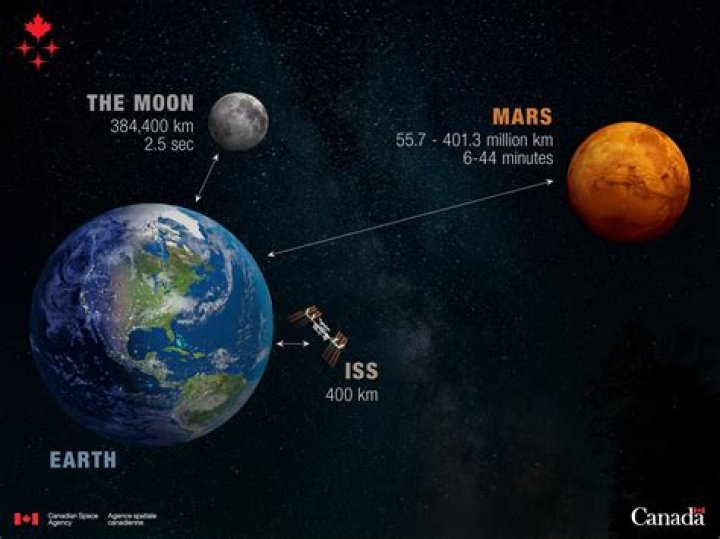
Understanding the distance of Mars from Earth has always fascinated astronomers and space enthusiasts alike. The red planet, often described as Earth's potential twin, holds mysteries that continue to intrigue scientists. As we delve deeper into the exploration of Mars, knowing its distance from Earth becomes crucial in planning missions and comprehending its position in our solar system.
Throughout history, humans have looked up at the night sky and wondered about the stars and planets. Mars, with its reddish appearance, stands out prominently. The fascination with this celestial body has driven humanity to send probes, rovers, and even plan manned missions to explore its surface.
As we progress through this article, we'll uncover the various aspects of Mars' distance from Earth, its implications, and the scientific breakthroughs that have helped us understand this phenomenon better. Let's embark on this cosmic journey together.
Basic Understanding of Mars Distance
Mars, the fourth planet from the Sun, orbits at an average distance of approximately 225 million kilometers (140 million miles) from Earth. However, this distance fluctuates due to the elliptical orbits of both planets. Understanding the basics of this distance is essential for appreciating the complexity of interplanetary travel.
For instance, when Mars and Earth are on opposite sides of the Sun, the distance increases significantly, making communication and travel more challenging. Conversely, when the two planets align favorably, the distance decreases, offering optimal conditions for missions.
Why is Mars Distance Important?
The distance of Mars from Earth affects:
- Spacecraft travel time
- Signal transmission delays
- Energy requirements for missions
Orbital Dynamics and Mars Distance
The orbital dynamics of Mars and Earth play a pivotal role in determining the distance between the two planets. Both planets follow elliptical orbits around the Sun, which means their distances vary throughout the year.
Earth completes one orbit around the Sun in about 365 days, while Mars takes approximately 687 Earth days. This difference in orbital periods creates a cycle where Mars and Earth come closer and then move farther apart over time.
Key Orbital Parameters
- Average distance: 225 million kilometers (140 million miles)
- Closest approach: 54.6 million kilometers (33.9 million miles)
- Furthest distance: 401 million kilometers (249 million miles)
Variation in Mars' Distance from Earth
The distance of Mars from Earth varies significantly due to the elliptical shape of their orbits. At times, Mars can be as close as 54.6 million kilometers (33.9 million miles), while at other times, it can be as far as 401 million kilometers (249 million miles).
This variation poses challenges for astronomers and engineers designing missions to Mars. Timing is crucial, as launching spacecraft during favorable alignments can reduce travel time and fuel consumption.
Factors Influencing Distance Variation
Several factors contribute to the fluctuation in Mars' distance from Earth:
- Elliptical orbits of both planets
- Relative speed of Earth and Mars
- Gravitational influences from other celestial bodies
Closest Approach: Opposition and Perihelic Opposition
The closest approach of Mars to Earth occurs during a phenomenon known as "opposition." During opposition, Mars, Earth, and the Sun align in a straight line, with Earth positioned between Mars and the Sun. This alignment brings Mars closer to Earth than at any other time in its orbit.
Even more rare and significant is the "perihelic opposition," when Mars is closest to the Sun and simultaneously aligned with Earth. This event occurs approximately every 15 to 17 years and offers the best conditions for observing Mars and launching missions.
Impact of Closest Approach
During closest approach:
- Mars appears brighter in the night sky
- Telescopic observations yield clearer images
- Mission planning becomes more efficient
Tools and Techniques for Measuring Mars Distance
Scientists use various tools and techniques to measure the distance of Mars from Earth accurately. These methods have evolved over time, from ancient observations to modern technological advancements.
One of the most common techniques today is radar ranging, where radio waves are transmitted to Mars and the time it takes for the signal to return is measured. This method provides precise distance measurements and has been instrumental in planning space missions.
Modern Measurement Techniques
- Radar ranging
- Optical telescopes
- Satellite observations
Historical Perspective of Mars Distance
Throughout history, humans have attempted to measure the distance of Mars from Earth using various methods. Early astronomers relied on geometric calculations and naked-eye observations, while modern scientists employ advanced technology.
One of the most significant breakthroughs came in the 17th century when Giovanni Cassini and Jean Richer used parallax measurements to estimate Mars' distance. Their work laid the foundation for future astronomical studies.
Key Historical Milestones
- 1672: Cassini and Richer's parallax measurements
- 1965: First successful radar ranging by NASA
- 2003: Closest approach in 60,000 years
Future Missions and Mars Distance
As humanity continues to explore Mars, understanding its distance from Earth remains crucial. Future missions aim to establish sustainable human presence on the red planet, requiring precise calculations of travel time and energy requirements.
NASA, SpaceX, and other space agencies are actively working on projects that will revolutionize interplanetary travel. These missions will leverage advanced propulsion systems and innovative technologies to overcome the challenges posed by Mars' distance.
Upcoming Missions
- NASA's Artemis Program
- SpaceX's Starship missions
- ESA's ExoMars mission
Scientific Importance of Mars Distance
The distance of Mars from Earth has profound implications for scientific research. By studying Mars' position and movement, scientists gain insights into planetary dynamics, climate change, and the potential for life beyond Earth.
Additionally, understanding Mars' distance helps in planning and executing missions that contribute to our knowledge of the solar system and beyond. These missions often lead to technological advancements that benefit humanity in various ways.
Key Areas of Research
- Planetary dynamics
- Exoplanet studies
- Potential for human colonization
Conclusion
In conclusion, the distance of Mars from Earth is a critical factor in space exploration and scientific research. By understanding the orbital dynamics, measurement techniques, and historical milestones, we can appreciate the complexity and significance of this cosmic relationship.
We invite you to share your thoughts and questions in the comments section below. Additionally, explore other articles on our site to deepen your knowledge of the universe and its wonders. Together, let's continue to unravel the mysteries of the cosmos!




