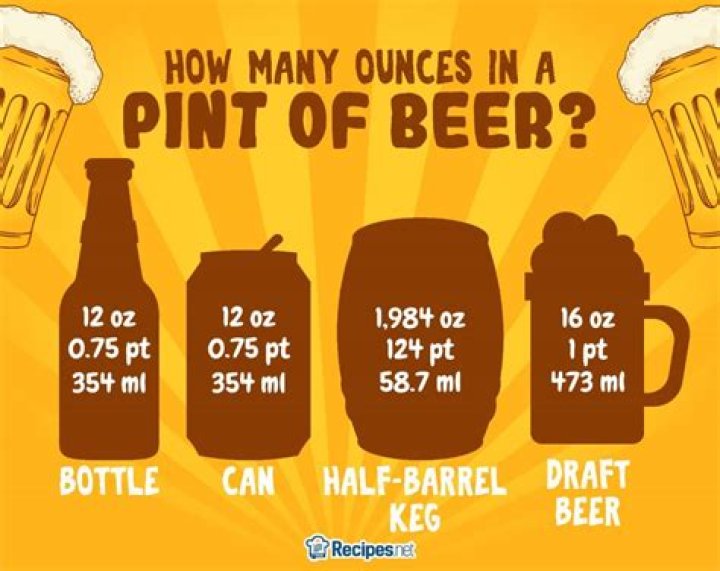
Understanding measurements is essential in both cooking and everyday life, and one common question that arises is, "How many ounces is a pint?" Whether you're measuring liquids for a recipe or calculating how much liquid you need for hydration, knowing the conversion between pints and ounces is crucial. This guide will help you understand the relationship between these two units of measurement, so you're always prepared.
As we dive deeper, you'll learn that the answer isn't as straightforward as it seems. The number of ounces in a pint can vary depending on the measurement system being used—whether imperial or U.S. customary. This article will break down the differences and provide clarity so you can confidently measure liquids.
By the end of this guide, you'll have a solid understanding of how many ounces are in a pint, the importance of accurate measurements, and how to apply this knowledge in practical scenarios. Let's get started!
What Is a Pint?
A pint is a unit of volume used primarily in the United States and the United Kingdom. It is commonly used for measuring liquids such as milk, beer, and other beverages. The term "pint" originates from the Latin word "pincta," which referred to a mark on a container indicating its capacity.
In different regions, the pint has slightly different volumes. For example, the U.S. pint is smaller than the imperial pint used in the UK. This variation is important to note, especially when traveling or working with international recipes.
Understanding the U.S. Pint
The U.S. pint is defined as exactly 16 fluid ounces. This measurement is part of the U.S. customary system and is widely used in recipes, cooking, and everyday life in the United States. When someone in the U.S. asks, "How many ounces is a pint?" the answer is straightforward: 16 ounces.
Here are some key points about the U.S. pint:
- 1 U.S. pint = 16 U.S. fluid ounces
- 1 U.S. pint = 473.176 milliliters
- Commonly used in American recipes and beverages
The Imperial Pint
The imperial pint, used in the United Kingdom and some Commonwealth countries, is slightly larger than the U.S. pint. An imperial pint equals 20 imperial fluid ounces or approximately 568.261 milliliters. This difference is important to consider when converting recipes or measurements between the U.S. and UK systems.
Key facts about the imperial pint:
- 1 imperial pint = 20 imperial fluid ounces
- 1 imperial pint ≈ 568.261 milliliters
- Primarily used in the UK and some former British colonies
Conversions Between Pints and Ounces
Knowing how to convert between pints and ounces is essential for accurate measurements. Below is a breakdown of the conversions for both U.S. and imperial systems:
- U.S. system: 1 pint = 16 ounces
- Imperial system: 1 pint = 20 ounces
For larger quantities, here are some additional conversions:
- 2 U.S. pints = 32 ounces
- 2 imperial pints = 40 ounces
- 4 U.S. pints = 64 ounces (half a gallon)
- 4 imperial pints = 80 ounces
These conversions can be particularly useful when scaling recipes up or down or when working with larger volumes of liquid.
Why Accurate Measurements Matter
Accurate measurements are crucial in various fields, including cooking, science, and engineering. In cooking, even small discrepancies in measurements can affect the taste, texture, and overall quality of a dish. For example, using the wrong amount of liquid in a recipe can lead to soupy or dry results.
Here are a few reasons why precision is important:
- Ensures consistency in recipes
- Prevents wastage of ingredients
- Improves the quality of the final product
When it comes to answering the question, "How many ounces is a pint?" understanding the exact measurement ensures that you're following recipes correctly and achieving the desired outcome.
Practical Uses of Pint Measurements
Pint measurements are commonly used in everyday life, from cooking to hydration tracking. Here are some practical examples:
1. Cooking and Baking
Recipes often call for liquids measured in pints or ounces. For instance, a soup recipe might require 2 pints of chicken broth, which is equivalent to 32 ounces in the U.S. system. Understanding these conversions ensures that you add the right amount of liquid to your dish.
2. Hydration
Health experts often recommend drinking a certain number of pints of water per day. For example, the common guideline of drinking 8 cups of water per day is equivalent to 4 pints (or 64 ounces) in the U.S. system. Knowing this conversion helps you track your hydration more effectively.
3. Beverage Sales
In bars and restaurants, drinks are often served in pint-sized glasses. Understanding the volume of a pint helps you estimate how much you're consuming and make informed choices about portion sizes.
Common Questions About Pints
Here are some frequently asked questions related to pints and their conversions:
1. Is a pint always 16 ounces?
No, the number of ounces in a pint depends on the measurement system. In the U.S., a pint is 16 ounces, while in the UK, it's 20 ounces.
2. How do I convert pints to milliliters?
To convert pints to milliliters, use the following formulas:
- U.S. pint: 1 pint = 473.176 milliliters
- Imperial pint: 1 pint ≈ 568.261 milliliters
3. Can I use a pint for dry ingredients?
While pints are primarily used for liquids, they can also be used for dry ingredients. However, it's important to note that the volume of dry ingredients can vary depending on their density, so weigh them for more accurate measurements.
Tools for Measuring Pints and Ounces
Having the right tools can make measuring liquids easier and more accurate. Here are some commonly used tools:
- Measuring cups: Available in both U.S. and metric systems, these cups are essential for measuring liquids and dry ingredients.
- Graduated cylinders: Often used in laboratories, these tools provide precise measurements of liquids.
- Kitchen scales: While primarily used for dry ingredients, scales can also help measure the weight of liquids for more accuracy.
Investing in high-quality measuring tools ensures that your measurements are as accurate as possible.
How to Use Pints in Recipes
Recipes often call for specific measurements, and understanding how to use pints can make cooking easier. Here's a step-by-step guide:
- Identify the measurement system used in the recipe (U.S. or imperial).
- Convert the recipe's measurements to the system you're familiar with, if necessary.
- Use appropriate measuring tools to ensure accuracy.
For example, if a recipe calls for 1 pint of milk, measure out 16 ounces in the U.S. system or 20 ounces in the imperial system.
Conclusion
In conclusion, understanding how many ounces are in a pint is essential for accurate measurements in cooking, hydration, and other daily activities. Whether you're working with the U.S. system or the imperial system, knowing the differences and how to convert between them will help you achieve the best results.
We encourage you to share this article with others who might find it helpful and leave a comment below if you have any questions or additional tips. For more informative content, explore our other articles on measurement conversions and cooking tips!




