Have you ever wondered how the date for Easter is decided each year? Unlike fixed holidays, Easter moves around the calendar, making it unique and intriguing. The process behind determining its date involves a fascinating blend of religious tradition, astronomical calculations, and historical significance. This article will take you on a journey to understand the complexities behind Easter's date determination.
Easter is one of the most important Christian holidays, celebrated by millions worldwide. Its date is not set in stone but instead depends on a combination of lunar cycles and the vernal equinox. This makes it a "movable feast," meaning it falls on different dates each year. Understanding how this date is decided can deepen your appreciation for the traditions and history behind this sacred celebration.
In this article, we'll explore the intricate process of determining Easter's date, delve into its historical roots, and examine why it varies annually. Whether you're curious about the science behind it or simply want to know when to mark your calendar, this guide has everything you need to understand how Easter's date is decided.
The History of Easter's Date Determination
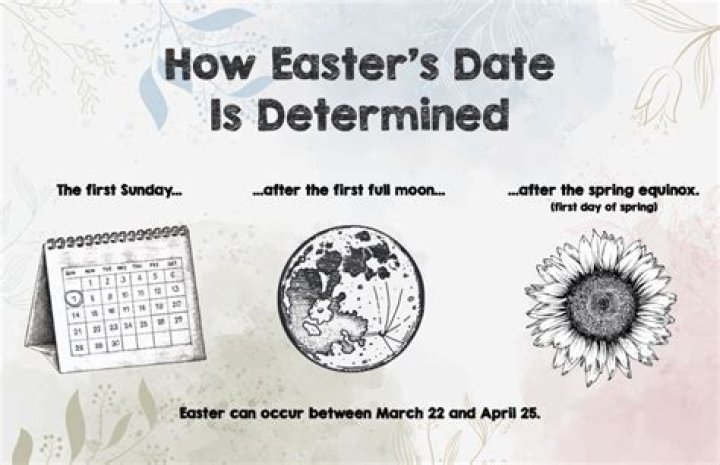
Easter's date determination dates back to the early days of Christianity. The Council of Nicaea in 325 AD established the rules for calculating Easter's date, aiming to unify the Christian world. Before this, different regions celebrated Easter at various times, leading to confusion and division. The council decided that Easter should fall on the first Sunday after the first full moon following the vernal equinox.
This decision was rooted in the Jewish Passover, which influenced early Christian practices. By aligning Easter with the lunar cycle and the equinox, the council ensured that the holiday retained its symbolic connection to the resurrection of Jesus Christ. Over time, this method became the standard for determining Easter's date across most Christian denominations.
Early Challenges in Determining Easter's Date
In the early centuries of Christianity, determining Easter's date was not straightforward. Discrepancies arose due to differences in calendars and astronomical observations. For instance, the Julian calendar, which was widely used at the time, did not accurately account for the length of the year, leading to gradual drifts in the equinox date.
To address these issues, the Church developed complex systems like the Golden Number and the Epact, which we'll explore in detail later. These tools helped standardize the calculation process and reduce inconsistencies. Despite these efforts, variations in Easter's date still exist today, particularly between Western and Eastern Christian traditions.
The Method for Deciding Easter's Date
At the heart of Easter's date determination lies a precise formula that considers both lunar and solar cycles. The basic rule is that Easter falls on the first Sunday after the first full moon following the vernal equinox. However, this seemingly simple rule involves several layers of complexity, especially when accounting for calendar adjustments and historical practices.
The Formula for Easter's Date
To calculate Easter's date, follow these steps:
- Identify the year's Golden Number, which represents the position of the year in the 19-year Metonic cycle.
- Determine the Epact, which indicates the age of the moon on January 1st.
- Find the Paschal Full Moon, the first full moon after the vernal equinox.
- Locate the first Sunday after the Paschal Full Moon. This is Easter Sunday.
While this formula may seem complicated, it ensures that Easter aligns with the natural cycles of the earth and moon, maintaining its spiritual significance.
Understanding the Golden Number
The Golden Number is a critical component in calculating Easter's date. It represents the year's position within the 19-year Metonic cycle, a period during which the phases of the moon recur on the same calendar dates. This cycle was named after the ancient Greek astronomer Meton, who first discovered it in the 5th century BC.
To find the Golden Number for a given year, divide the year by 19 and take the remainder. Add 1 to the remainder to get the Golden Number. For example, the Golden Number for 2023 is 8, as (2023 ÷ 19) leaves a remainder of 7, and 7 + 1 = 8. This number helps determine the timing of the Paschal Full Moon and, consequently, Easter's date.
The Role of the Epact
The Epact is another essential element in the calculation of Easter's date. It represents the age of the moon on January 1st, measured in days. The Epact is used to determine the date of the Paschal Full Moon, which in turn influences Easter's placement.
Historically, the Epact was calculated using a complex table system developed by medieval astronomers. Today, modern algorithms simplify this process, ensuring accuracy while maintaining the historical integrity of the calculation method. By incorporating the Epact, the Church ensures that Easter remains aligned with the lunar cycle.
Variations in Easter Dates Between Churches
While the majority of Christians follow the same basic rules for determining Easter's date, variations exist between Western and Eastern Christian traditions. The primary reason for these differences lies in the use of different calendars. Western churches, such as the Roman Catholic and Protestant denominations, use the Gregorian calendar, while Eastern Orthodox churches adhere to the Julian calendar.
This discrepancy can result in Easter being celebrated on different dates, sometimes weeks apart. For example, in 2023, Western Easter falls on April 9th, while Eastern Orthodox Easter is observed on April 16th. Despite these differences, both traditions share the same core beliefs and celebrations surrounding Easter.
Efforts to Unify Easter Dates
Efforts to unify Easter's date have been ongoing for decades, with various proposals aiming to create a single, fixed date for the holiday. However, these attempts have faced resistance from traditionalists who value the historical and cultural significance of the current calculation methods. As a result, the differences in Easter dates persist, reflecting the rich diversity of Christian practices worldwide.
The Science Behind the Lunar Cycle
Understanding the science behind the lunar cycle is crucial for grasping how Easter's date is determined. The moon completes one full cycle of phases approximately every 29.5 days, a period known as a synodic month. This cycle is closely tied to the earth's orbit around the sun and the tilt of its axis.
The vernal equinox, which marks the beginning of spring in the Northern Hemisphere, occurs around March 20th or 21st. Easter's date is calculated based on the first full moon after this equinox, ensuring that the holiday always falls within the spring season. By aligning Easter with these natural phenomena, the Church emphasizes its connection to renewal and rebirth, central themes in the Easter story.
Astronomical Impact on Easter's Date
Astronomical factors such as leap years and calendar adjustments can influence Easter's date. For instance, the Gregorian calendar, introduced in 1582, corrected the inaccuracies of the Julian calendar by adjusting the number of leap years. This change helped stabilize the vernal equinox and improve the accuracy of Easter's date determination.
Modern technology, including satellite observations and computer modeling, further enhances our understanding of the lunar cycle and its impact on Easter's date. These advancements ensure that the calculations remain precise, even as the earth's movements evolve over time.
Cultural and Religious Traditions Around Easter
Easter is not only a religious holiday but also a time of cultural celebration for many communities around the world. From Easter egg hunts to elaborate church services, the traditions surrounding this holiday vary widely. Understanding these practices provides insight into the significance of Easter's date and its role in shaping global cultures.
In many Western countries, Easter is marked by family gatherings, festive meals, and symbolic rituals like dyeing eggs. These customs often blend religious elements with secular traditions, creating a unique tapestry of observance. Meanwhile, Eastern Orthodox communities celebrate with vibrant processions and traditional foods, reflecting their distinct cultural heritage.
The Symbolism of Easter's Date
Easter's date holds deep symbolic meaning, representing the resurrection of Jesus Christ and the promise of eternal life. By aligning the holiday with the vernal equinox and the lunar cycle, the Church emphasizes themes of renewal, hope, and transformation. These symbols resonate with people of all backgrounds, making Easter a universal celebration of life and faith.
How the Gregorian Calendar Affects Easter
The adoption of the Gregorian calendar in 1582 significantly impacted the calculation of Easter's date. Designed to correct the inaccuracies of the Julian calendar, the Gregorian system introduced a more precise method for determining leap years. This adjustment stabilized the vernal equinox and improved the accuracy of Easter's placement on the calendar.
However, the transition to the Gregorian calendar was not immediate, with many countries adopting it at different times. This led to temporary discrepancies in Easter's date until the new system was universally accepted. Today, the Gregorian calendar remains the standard for most Western Christian traditions, ensuring consistency in Easter's celebration.
The Historical Transition to the Gregorian Calendar
The switch from the Julian to the Gregorian calendar was a gradual process, met with resistance in some regions. Catholic countries were the first to adopt the new system, followed by Protestant and Orthodox nations over the centuries. This transition highlights the complexity of aligning religious practices with scientific advancements, a challenge that continues to shape Easter's date determination today.
Frequently Asked Questions About Easter's Date
Q: Why does Easter's date change every year?
Easter's date changes annually because it is based on the lunar cycle and the vernal equinox. Unlike fixed holidays, Easter is a "movable feast," meaning its placement depends on the timing of the first full moon after the equinox.
Q: Can Easter ever fall in March?
Yes, Easter can fall in March, although this is relatively rare. The earliest possible date for Easter is March 22nd, which occurs when the Paschal Full Moon falls immediately after the vernal equinox.
Q: Why do Western and Eastern Easter dates differ?
Western and Eastern Easter dates differ primarily due to the use of different calendars. Western churches use the Gregorian calendar, while Eastern Orthodox churches adhere to the Julian calendar, resulting in variations in the calculation of the vernal equinox and the Paschal Full Moon.
Conclusion: Understanding the Importance of Easter's Date
In conclusion, the process of determining Easter's date is a fascinating blend of religious tradition, astronomical science, and historical significance. By understanding the methods and factors involved, we gain a deeper appreciation for this sacred holiday and its role in shaping global cultures. Whether you're celebrating Easter in the Western or Eastern tradition, its date serves as a reminder of the enduring themes of renewal and hope that unite us all.
We invite you to share your thoughts and experiences about Easter in the comments below. Have you noticed any unique traditions or celebrations in your community? Additionally, explore our other articles to learn more about the rich history and significance of Christian holidays. Together, let's celebrate the beauty and diversity of faith and culture!




