Understanding the difference between centripetal and centrifugal forces is essential for anyone studying physics or engineering. These forces play a crucial role in various natural phenomena and technological applications. By delving into their definitions, characteristics, and practical examples, we can gain a deeper understanding of how they influence the motion of objects.
In the realm of physics, forces are the driving factors behind the motion of objects. Whether it's the motion of celestial bodies, the operation of amusement park rides, or the stability of vehicles navigating curves, centripetal and centrifugal forces are at work. In this article, we will explore these forces in detail, providing you with a clear distinction between them.
Our focus will be on explaining the fundamental principles, applications, and real-world scenarios where these forces are observed. Whether you're a student, educator, or simply someone curious about the mechanics of motion, this article will serve as a valuable resource.
What is Centripetal Force?
Centripetal force refers to the force that acts on an object moving in a circular path, pulling it toward the center of the circle. Without this inward force, the object would continue moving in a straight line due to inertia, as described by Newton's first law of motion. This force is always directed perpendicular to the motion of the object and toward the fixed point of the center of the circle.
Some key characteristics of centripetal force include:
- Direction: Always acts toward the center of the circular path.
- Magnitude: Calculated using the formula \( F = \frac{mv^2}{r} \), where \( F \) is the force, \( m \) is the mass of the object, \( v \) is its velocity, and \( r \) is the radius of the circular path.
- Examples: Tension in a string, gravitational force, and friction are common sources of centripetal force.
What is Centrifugal Force?
Centrifugal force, on the other hand, is often misunderstood as a force acting outward from the center of a circular path. In reality, it is a fictitious or pseudo-force experienced in a rotating reference frame. It appears to push objects away from the center of rotation, but it is not a real force in the inertial reference frame.
Centrifugal force arises due to the inertia of an object and is observed when analyzing motion from a non-inertial frame of reference. For example, when you're in a car making a sharp turn, you feel pushed outward. This sensation is due to centrifugal force.
Key Differences Between Centripetal and Centrifugal Force
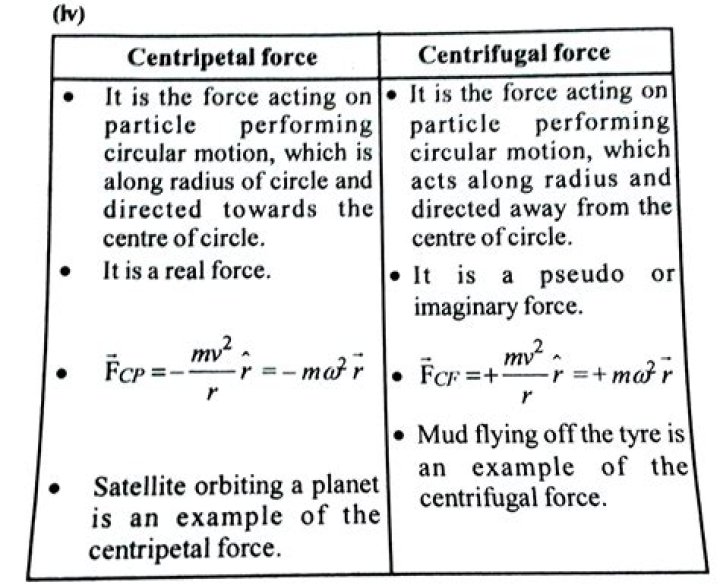
While both forces are related to circular motion, they differ significantly in their nature and effects. Below is a detailed comparison:
- Type: Centripetal force is a real force, while centrifugal force is a fictitious force.
- Direction: Centripetal force acts toward the center, whereas centrifugal force appears to act outward.
- Frame of Reference: Centripetal force is observed in an inertial frame, while centrifugal force is experienced in a non-inertial frame.
Mathematical Representation of Both Forces
The mathematical representation of centripetal and centrifugal forces helps in understanding their behavior quantitatively. The formula for centripetal force is:
\( F_c = \frac{mv^2}{r} \)
Where:
- \( F_c \): Centripetal force
- \( m \): Mass of the object
- \( v \): Velocity of the object
- \( r \): Radius of the circular path
Centrifugal force, being a fictitious force, does not have an independent formula but is mathematically equivalent to centripetal force in magnitude when observed from a rotating frame:
\( F_{cf} = \frac{mv^2}{r} \)
Real-World Applications of Centripetal Force
Centripetal force is evident in numerous real-world scenarios. Here are some examples:
- Planetary Motion: Gravitational force acts as the centripetal force keeping planets in orbit around the sun.
- Banked Roads: Roads are banked at curves to provide the necessary centripetal force for vehicles to navigate safely.
- Amusement Park Rides: Rides like the Ferris wheel and roller coasters rely on centripetal force to keep passengers moving in circular paths.
Real-World Applications of Centrifugal Force
Centrifugal force, though fictitious, has practical implications in various applications:
- Washing Machines: The spin cycle in washing machines uses centrifugal force to remove water from clothes.
- Centrifuges: These devices separate substances based on density using centrifugal force.
- Artificial Gravity: In space exploration, centrifugal force is used to simulate gravity in rotating habitats.
Common Misconceptions About Centripetal and Centrifugal Forces
There are several misconceptions surrounding these forces. Below are some common ones:
- Centrifugal Force is Real: Many people believe centrifugal force is a real force, but it is actually a fictitious force.
- Opposite Forces: Centripetal and centrifugal forces are not opposite forces; they operate in different reference frames.
- Centripetal Force Cancels Out: Centripetal force does not cancel out centrifugal force; they coexist in different contexts.
Historical Development of the Concept
The concepts of centripetal and centrifugal forces have evolved over centuries through the contributions of notable scientists. Isaac Newton was the first to formally describe centripetal force in his laws of motion. Later, the idea of centrifugal force was developed to explain motion in non-inertial frames.
These concepts have been refined and expanded upon by physicists, leading to a deeper understanding of motion and its underlying principles.
Newton's Contribution to Centripetal Force
Newton's work on centripetal force laid the foundation for classical mechanics. He demonstrated that the force required to keep an object moving in a circular path is directed toward the center. This principle is fundamental to understanding planetary motion and other natural phenomena.
Experimental Demonstrations
Various experiments can demonstrate the effects of centripetal and centrifugal forces. For example, swinging a ball attached to a string in a circular path illustrates centripetal force. Similarly, using a rotating platform can simulate centrifugal force.
These hands-on demonstrations help students and enthusiasts grasp the concepts more effectively.
Conclusion
In conclusion, understanding the difference between centripetal and centrifugal forces is crucial for comprehending the mechanics of circular motion. Centripetal force is a real force that acts toward the center of a circular path, while centrifugal force is a fictitious force experienced in a rotating reference frame. Both forces have significant applications in everyday life and scientific research.
We encourage you to explore further by conducting your own experiments or reading related articles. If you have any questions or insights, feel free to leave a comment below. Additionally, don't forget to share this article with others who might find it informative!




