Understanding the concepts of centripetal and centrifugal forces is essential for anyone interested in physics, engineering, or even everyday phenomena. These forces play a crucial role in the motion of objects moving in circular paths. Whether you're observing the motion of planets, a spinning amusement park ride, or even a simple pendulum, the principles of centripetal and centrifugal forces come into play. In this article, we will delve deep into the differences between these forces, their real-world applications, and how they shape the world around us.
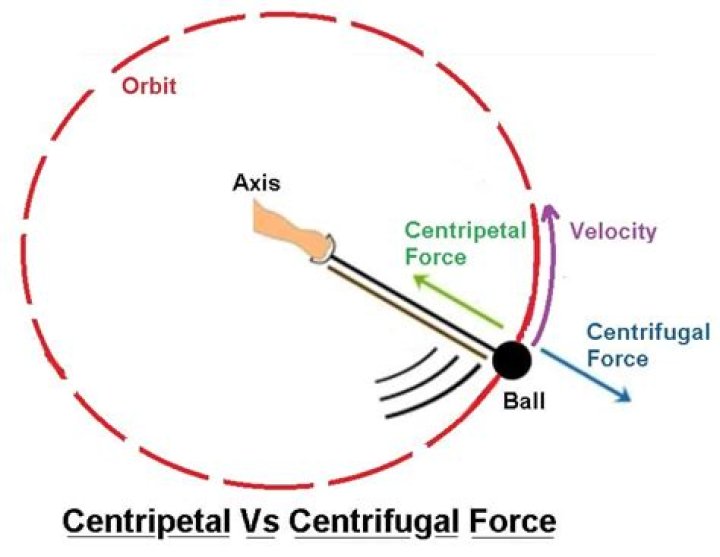
Centripetal and centrifugal forces are often misunderstood or confused with one another, but they represent two distinct concepts in physics. Centripetal force is the inward force that keeps an object moving in a circular path, while centrifugal force is the apparent outward force experienced by objects in rotation. Understanding the nuances of these forces is not only fascinating but also crucial for many scientific and engineering applications.
In this comprehensive guide, we will explore the definitions, formulas, differences, and practical uses of centripetal and centrifugal forces. By the end of this article, you will have a clear understanding of how these forces work and their significance in various fields. Let's dive in!
Introduction to Centripetal and Centrifugal Forces
Centripetal and centrifugal forces are fundamental concepts in classical mechanics. These forces are responsible for the motion of objects in circular paths, such as planets orbiting the sun, cars navigating curves, and even the spinning of a washing machine drum. To fully grasp these forces, it's important to understand their definitions and how they differ from one another.
Centripetal force is the inward force that acts toward the center of a circular path, keeping an object in motion along that path. On the other hand, centrifugal force is the apparent outward force felt by objects moving in rotation, as observed in a rotating reference frame. Both forces are integral to understanding the mechanics of circular motion.
Centripetal Force: Definition and Formula
What is Centripetal Force?
Centripetal force is the force that pulls an object toward the center of a circular path. Without this force, an object in motion would continue in a straight line due to inertia. The centripetal force ensures that the object follows a curved trajectory.
The formula for centripetal force is:
Fc = mv²/r
- Fc = Centripetal force
- m = Mass of the object
- v = Velocity of the object
- r = Radius of the circular path
Examples of Centripetal Force
Centripetal force can be observed in various scenarios, such as:
- A car taking a turn on a curved road
- A satellite orbiting Earth
- A ball tied to a string being swung in a circular motion
Centrifugal Force: Definition and Formula
What is Centrifugal Force?
Centrifugal force is the apparent outward force experienced by objects in a rotating reference frame. It is not a real force but rather an inertial effect caused by the object's tendency to move in a straight line due to inertia. Centrifugal force is often described as the "opposite" of centripetal force.
The formula for centrifugal force is:
Fcf = mv²/r
It is mathematically identical to the formula for centripetal force, but its direction is opposite.
Examples of Centrifugal Force
Centrifugal force can be observed in situations like:
- A rider feeling pushed outward on a spinning amusement park ride
- Water being flung outward in a spinning washing machine drum
- A car passenger leaning outward while taking a sharp turn
Key Differences Between Centripetal and Centrifugal Forces
Direction of the Forces
The primary difference between centripetal and centrifugal forces lies in their direction. Centripetal force always acts toward the center of the circular path, while centrifugal force acts outward, away from the center.
Reference Frames
Centripetal force exists in an inertial reference frame, whereas centrifugal force is observed only in a non-inertial (rotating) reference frame. This distinction is crucial for understanding their roles in different physical scenarios.
Real vs. Apparent
Centripetal force is a real force that can be measured and observed, while centrifugal force is an apparent force that arises due to inertia in a rotating system. This difference makes centripetal force more fundamental in physics.
Real-World Applications of Centripetal and Centrifugal Forces
Transportation
In the field of transportation, centripetal force is essential for vehicles navigating curves safely. Engineers design roads and tracks with appropriate banking angles to ensure that centripetal force counteracts the tendency of vehicles to slide outward.
Aerospace Engineering
Satellites and spacecraft rely on centripetal force to maintain their orbits around celestial bodies. Understanding this force is critical for designing successful space missions.
Everyday Life
Centrifugal force is commonly experienced in everyday situations, such as when water is spun out of clothes in a washing machine or when you feel pushed outward on a merry-go-round.
Scientific Explanation of Circular Motion
To fully comprehend centripetal and centrifugal forces, it's important to understand the physics behind circular motion. Newton's laws of motion explain why objects in circular paths require a centripetal force to maintain their trajectory. Additionally, the concept of inertia plays a significant role in explaining centrifugal force as an inertial effect.
Common Misconceptions About These Forces
Many people confuse centripetal and centrifugal forces or believe that centrifugal force is a real force. Clearing up these misconceptions is essential for a deeper understanding of circular motion.
Mathematical Examples and Calculations
Example 1: Car Negotiating a Curve
Suppose a car of mass 1,000 kg is traveling at a speed of 20 m/s around a curve with a radius of 50 meters. The centripetal force required to keep the car on the curve can be calculated using the formula:
Fc = mv²/r
Fc = (1000)(20)² / 50 = 8,000 N
Example 2: Satellite Orbiting Earth
A satellite of mass 500 kg is orbiting Earth at a distance of 400 km above the surface. The centripetal force required to maintain its orbit can be calculated using gravitational force as the centripetal force:
Fc = G * (m₁ * m₂) / r²
Where G is the gravitational constant, m₁ is the mass of Earth, and m₂ is the mass of the satellite.
Importance in Engineering and Technology
Centripetal and centrifugal forces are critical in various engineering disciplines. From designing roller coasters to developing advanced satellite systems, engineers rely on these principles to create safe and efficient systems. Understanding these forces allows engineers to optimize performance and minimize risks in various applications.
Conclusion and Key Takeaways
In conclusion, centripetal and centrifugal forces are essential concepts in physics that govern the motion of objects in circular paths. Centripetal force acts toward the center of the circular path, while centrifugal force is an apparent outward force experienced in rotating systems. These forces have numerous real-world applications, from transportation to space exploration.
To deepen your understanding of these forces, consider exploring related topics such as Newton's laws of motion, inertia, and gravitational forces. We encourage you to share this article with others who might find it interesting or leave a comment below with your thoughts and questions.
For further reading, check out authoritative sources such as NASA's educational resources and peer-reviewed physics journals to expand your knowledge of circular motion and its applications.




