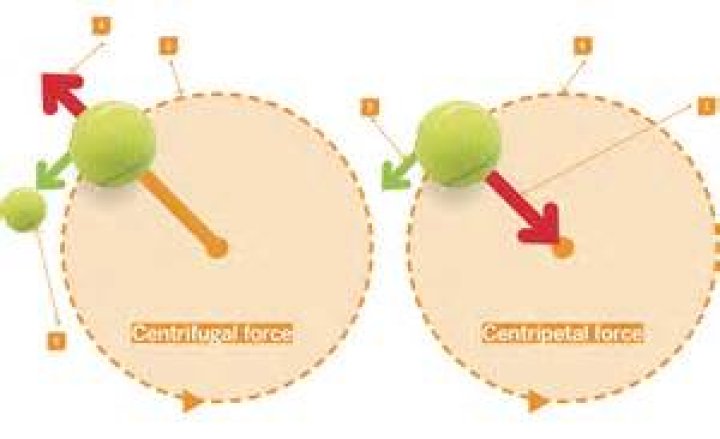
Centripetal vs centrifugal force examples are fundamental concepts in physics that play a significant role in understanding motion in circular paths. Whether you're studying for an exam, working on a science project, or simply curious about how forces work, this article provides an in-depth exploration of both forces. By the end of this article, you'll have a clear understanding of how these forces differ, their applications, and why they matter.
Centripetal and centrifugal forces are often misunderstood because they seem similar at first glance. However, they represent opposite concepts and have distinct roles in the physical world. Understanding the differences between these forces is essential for grasping how objects move in circular motion.
This article aims to provide a comprehensive overview of centripetal vs centrifugal force examples, supported by real-life applications, scientific explanations, and expert insights. Let's dive deeper into the world of physics and explore these fascinating concepts!
Introduction to Centripetal and Centrifugal Forces
In the realm of physics, forces play a pivotal role in shaping the way objects interact with one another. Among these forces, centripetal and centrifugal forces stand out due to their unique characteristics. These forces are particularly relevant when discussing motion in curved or circular paths.
What Are Forces in Physics?
Forces are interactions between objects that cause them to accelerate, decelerate, or change direction. Centripetal and centrifugal forces are specific types of forces that arise when an object moves in a circular trajectory. Understanding these forces is essential for fields such as engineering, astronomy, and even everyday activities like driving a car around a bend.
Centripetal Force: Definition and Importance
Centripetal force is the inward force that acts on an object moving in a circular path, directing it toward the center of the circle. Without this force, the object would move in a straight line due to inertia. This concept is governed by Newton's laws of motion and is a cornerstone of classical mechanics.
Key Characteristics of Centripetal Force
- Acts toward the center of the circular path.
- Depends on the mass of the object, its velocity, and the radius of the circle.
- Is a real force that can be measured and observed.
Mathematically, centripetal force is expressed as \( F_c = \frac{mv^2}{r} \), where \( m \) is the mass of the object, \( v \) is its velocity, and \( r \) is the radius of the circle.
Centrifugal Force: Definition and Misconceptions
Centrifugal force, on the other hand, is often misunderstood as an outward force acting on an object in circular motion. However, it is not a real force but rather a fictitious force that arises due to the observer's frame of reference. It is only apparent in non-inertial frames of reference, such as when you're inside a spinning object.
Why Is Centrifugal Force Considered Fictitious?
Centrifugal force is a result of inertia and the tendency of objects to continue moving in a straight line unless acted upon by an external force. In an inertial frame of reference, such as standing outside a spinning carousel, you would observe the centripetal force keeping the objects in motion. However, from the perspective of someone on the carousel, it feels as though an outward force is pushing them away.
Key Differences Between Centripetal and Centrifugal Forces
While centripetal and centrifugal forces are related, they differ significantly in their nature, direction, and application. Below are some key distinctions:
- Direction: Centripetal force acts toward the center of the circle, while centrifugal force acts outward.
- Reality: Centripetal force is a real force, whereas centrifugal force is fictitious.
- Frame of Reference: Centripetal force is observed in inertial frames, while centrifugal force is observed in non-inertial frames.
Examples of Centripetal Force
Centripetal force is at work in many everyday scenarios. Below are some practical examples:
Planetary Motion
The gravitational pull between the Earth and the Sun acts as a centripetal force, keeping the Earth in its orbit. This force ensures that the Earth follows a nearly circular path around the Sun.
Car Turning a Corner
When a car turns a corner, the friction between the tires and the road provides the necessary centripetal force to keep the car moving in a circular path. Without this force, the car would continue moving in a straight line.
Swinging a Bucket of Water
When you swing a bucket of water in a vertical circle, the tension in your arm and the force of gravity combine to create the centripetal force that keeps the water inside the bucket.
Examples of Centrifugal Force
Although centrifugal force is fictitious, it can still be observed in certain situations. Here are some examples:
Riding a Merry-Go-Round
When you're on a merry-go-round, you feel as though you're being pushed outward. This sensation is due to the centrifugal force, which arises because you're in a non-inertial frame of reference.
Centrifuges in Labs
Centrifuges are devices used in laboratories to separate substances based on their density. The rapid spinning creates a centrifugal force that pushes heavier particles outward, allowing them to settle at the bottom of the container.
Mathematical Analysis of Centripetal and Centrifugal Forces
Understanding the mathematics behind these forces is crucial for grasping their behavior. Let's explore the equations and calculations involved:
Centripetal Force Formula
The formula for centripetal force is:
\( F_c = \frac{mv^2}{r} \)
Where:
- \( F_c \) is the centripetal force.
- \( m \) is the mass of the object.
- \( v \) is the velocity of the object.
- \( r \) is the radius of the circular path.
Centrifugal Force Formula
Although centrifugal force is fictitious, it can be mathematically represented as:
\( F_{cf} = -\frac{mv^2}{r} \)
The negative sign indicates that it acts in the opposite direction to centripetal force.
Real-World Applications
Centripetal and centrifugal forces have numerous applications in various fields:
Engineering
In engineering, centripetal force is crucial for designing roller coasters, ensuring that the cars remain on the tracks during sharp turns. Similarly, centrifugal force is used in the design of centrifuges for industrial applications.
Astronomy
In astronomy, centripetal force explains the motion of planets around stars and moons around planets. The gravitational force between celestial bodies acts as the centripetal force, keeping them in orbit.
Frequently Asked Questions
What is the difference between centripetal and centrifugal forces?
Centripetal force is a real force that acts toward the center of a circular path, while centrifugal force is a fictitious force that appears to act outward in non-inertial frames of reference.
Why is centrifugal force considered fictitious?
Centrifugal force is a result of inertia and only appears in non-inertial frames of reference. In an inertial frame, centripetal force explains the motion.
Conclusion and Call to Action
In conclusion, centripetal vs centrifugal force examples highlight the fascinating interplay of forces in circular motion. While centripetal force is a real and measurable force that keeps objects moving in circular paths, centrifugal force is a fictitious force that arises due to the observer's frame of reference. Understanding these concepts is essential for various fields, from engineering to astronomy.
We encourage you to explore more about these forces by experimenting with real-life examples or delving deeper into the mathematics behind them. Don't forget to leave a comment or share this article with others who might find it interesting. Together, let's deepen our understanding of the physical world!



