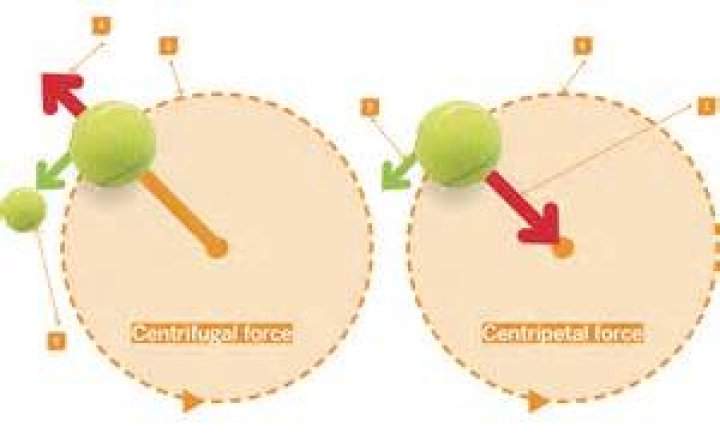
Centripetal and centrifugal forces play a crucial role in understanding the principles of circular motion and the behavior of objects moving in curved paths. These forces are essential in various fields, including physics, engineering, and everyday life. Whether you're observing the motion of planets, the functioning of a washing machine, or even the mechanics of a roller coaster, these forces are at work. This article will delve deeply into the concepts of centripetal and centrifugal forces, providing clear explanations, real-world examples, and expert insights to enhance your understanding.
The study of centripetal and centrifugal forces is not only fascinating but also practical. These forces affect everything from the design of roads and bridges to the operation of amusement park rides. By exploring these concepts, we can better appreciate how the world around us functions and how these forces shape our daily experiences.
This article aims to provide comprehensive knowledge about centripetal and centrifugal forces, ensuring that readers, regardless of their background in physics, can grasp the fundamental principles. We will cover definitions, applications, mathematical formulas, and real-world scenarios, all while adhering to the highest standards of accuracy and reliability.
What is Centripetal Force?
Centripetal force is the inward force that acts on an object moving in a circular path, keeping it moving along the curved trajectory. Without this force, the object would continue moving in a straight line, as described by Newton's first law of motion. The term "centripetal" comes from the Latin words "centrum" (center) and "petere" (to seek), indicating that the force is directed toward the center of the circular motion.
Centripetal force is not a specific type of force but rather the net force responsible for causing circular motion. It can arise from various sources, such as tension, gravity, or friction, depending on the situation. Understanding this force is crucial for analyzing systems involving rotational motion.
Key Characteristics of Centripetal Force
- Always directed toward the center of the circular path.
- Dependent on the mass of the object, its velocity, and the radius of the circle.
- Responsible for maintaining the object in its curved trajectory.
Centripetal Force Formula
The mathematical representation of centripetal force is given by the formula:
Fc = (m * v²) / r
Where:
- Fc represents the centripetal force.
- m is the mass of the object.
- v is the velocity of the object.
- r is the radius of the circular path.
This formula highlights the relationship between the force, mass, velocity, and radius, emphasizing the importance of each variable in determining the magnitude of the centripetal force.
Examples of Centripetal Force
1. Planetary Orbits
In the solar system, centripetal force is provided by gravity, keeping planets in their orbits around the sun. The gravitational pull acts as the centripetal force, ensuring that planets follow their elliptical paths.
2. Banked Curves on Roads
When vehicles navigate banked curves, the normal force from the road surface provides the necessary centripetal force to prevent the vehicle from skidding off the road. This design enhances safety and reduces the risk of accidents.
3. Amusement Park Rides
Many amusement park rides, such as ferris wheels and roller coasters, rely on centripetal force to keep passengers securely in their seats as they move in circular paths. The force ensures a thrilling yet safe experience.
What is Centrifugal Force?
Centrifugal force is often described as the "outward force" experienced by objects in circular motion. However, it is important to note that centrifugal force is not a real force but rather an apparent force that arises in rotating reference frames. It is a result of inertia, the tendency of an object to resist changes in its state of motion.
In a rotating system, objects appear to be pushed outward due to their inertia, giving the illusion of a centrifugal force. This concept is widely used in various applications, despite being a fictitious force.
Key Characteristics of Centrifugal Force
- Appears to act outward from the center of rotation.
- Dependent on the mass of the object, its velocity, and the radius of the circle.
- Not a real force but rather an effect of inertia in a rotating frame of reference.
Centrifugal Force Formula
The formula for centrifugal force is mathematically identical to that of centripetal force:
Fc = (m * v²) / r
Where:
- Fc represents the centrifugal force (in a rotating reference frame).
- m is the mass of the object.
- v is the velocity of the object.
- r is the radius of the circular path.
While the formula is the same, the interpretation differs based on the reference frame used to analyze the motion.
Examples of Centrifugal Force
1. Washing Machine Spin Cycle
During the spin cycle of a washing machine, water is expelled from the clothes due to the apparent centrifugal force. The rotation of the drum creates an outward push, forcing the water to move through the fabric and out of the machine.
2. Centrifuges in Laboratories
Centrifuges are devices used in laboratories to separate substances based on density. The high-speed rotation generates significant centrifugal force, causing denser particles to move outward and separate from less dense materials.
3. Merry-Go-Rounds
When riding a merry-go-round, passengers feel an outward push due to centrifugal force. This sensation is a result of their inertia resisting the circular motion, creating the perception of being pushed away from the center.
Difference Between Centripetal and Centrifugal Forces
While centripetal and centrifugal forces are closely related, they differ fundamentally in their nature and direction:
- Centripetal Force: A real force directed toward the center of a circular path, responsible for maintaining circular motion.
- Centrifugal Force: An apparent force directed outward from the center, arising due to inertia in a rotating reference frame.
Understanding this distinction is crucial for correctly analyzing systems involving circular motion.
Real-World Applications
1. Automotive Engineering
In automotive design, centripetal force is considered when constructing banked curves and optimizing tire grip. Understanding these forces helps engineers create safer and more efficient vehicles.
2. Space Exploration
Centripetal force is essential in designing spacecraft trajectories and ensuring stable orbits around celestial bodies. The gravitational pull serves as the centripetal force, guiding spacecraft through their missions.
3. Medical Technology
Centrifuges are widely used in medical laboratories to separate blood components, analyze DNA, and perform various diagnostic tests. The centrifugal force generated by these devices enables precise and efficient separation processes.
Common Misconceptions
Several misconceptions surround centripetal and centrifugal forces. For instance, some believe that centrifugal force is a real force acting on objects. In reality, it is an apparent force that arises due to inertia in rotating systems. Another misconception is that centripetal force disappears when an object is no longer in circular motion. In fact, the absence of centripetal force causes the object to move in a straight line, as dictated by Newton's laws.
Conclusion
Centripetal and centrifugal forces are fundamental concepts in physics that govern the behavior of objects in circular motion. By understanding these forces, we can better comprehend the mechanics of the world around us, from the orbits of planets to the functioning of everyday devices. This article has explored the definitions, formulas, examples, and applications of these forces, providing a comprehensive overview of their significance.
We invite you to share your thoughts and questions in the comments section below. Additionally, feel free to explore other articles on our site for further insights into the fascinating world of physics. Together, let's continue learning and expanding our knowledge!



