Centrifugal and centripetal forces are two fundamental concepts in physics that play a crucial role in understanding motion and the behavior of objects in circular paths. These forces are often misunderstood, but they are essential in explaining various phenomena in our everyday lives. Whether it's the motion of planets, cars turning around a curve, or even the sensation you feel on a spinning amusement park ride, these forces are at work. In this article, we'll explore the differences between centrifugal and centripetal forces and their applications in real-world scenarios.
Many people confuse centrifugal force with centripetal force because they sound similar and are closely related. However, they have distinct characteristics and functions. To grasp their differences, it's important to delve into the physics behind them, their mathematical representations, and how they interact with one another. Understanding these forces not only enhances scientific knowledge but also provides practical insights into various mechanical systems and natural processes.
In this article, we'll explore the intricacies of centrifugal vs centripetal force, covering their definitions, applications, and significance. By the end of this guide, you'll have a clear understanding of how these forces shape the world around us and why they matter in both theoretical and applied physics. Let's dive into the details!
Definition of Centrifugal and Centripetal Forces
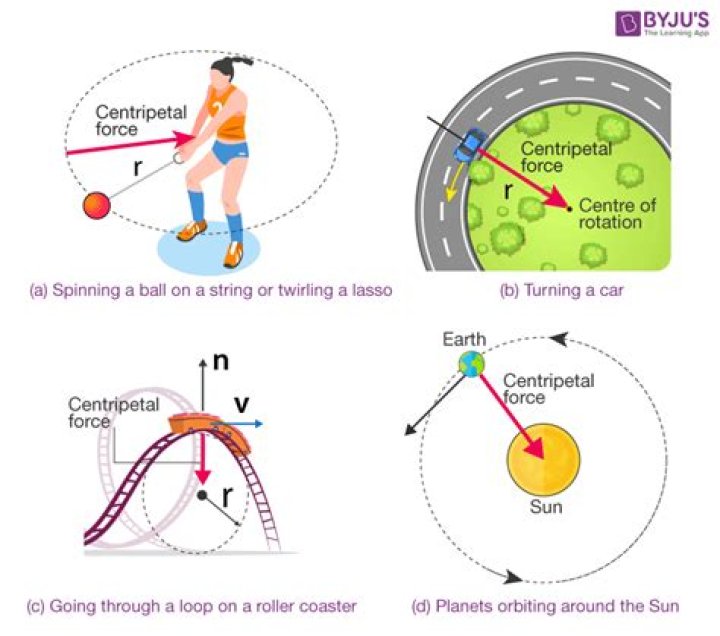
Centrifugal and centripetal forces are terms used in physics to describe the forces acting on objects moving in circular paths. Centripetal force is the inward force that keeps an object moving in a circular path, directed toward the center of the circle. On the other hand, centrifugal force is an outward force experienced by an object in a rotating reference frame, which appears to push the object away from the center.
Centripetal force is a real force that can be measured and observed, while centrifugal force is a fictitious force that arises due to the rotation of the reference frame. This distinction is crucial in understanding their roles in various physical phenomena.
Centripetal Force Explained
Centripetal force is the force that causes an object to follow a curved path and is always directed orthogonal to the motion of the body and toward the fixed point of the center of the curve. Without centripetal force, objects would continue moving in a straight line according to Newton's first law of motion.
Centrifugal Force Explained
Centrifugal force is often described as the force that seems to push objects away from the center of rotation. However, it is not a real force but rather an apparent force that arises in a rotating reference frame. It is the result of inertia, where objects tend to continue moving in a straight line unless acted upon by an external force.
Physics Behind Centrifugal and Centripetal Forces
To understand the physics behind centrifugal and centripetal forces, we need to delve into Newton's laws of motion and the principles of circular motion. According to Newton's first law, an object in motion will continue in a straight line unless acted upon by an external force. In circular motion, the centripetal force provides the necessary inward force to keep the object moving in a curved path.
Newton's second law explains that the force acting on an object is proportional to its mass and acceleration. In the case of circular motion, the centripetal force is given by the equation \( F = \frac{mv^2}{r} \), where \( F \) is the centripetal force, \( m \) is the mass of the object, \( v \) is its velocity, and \( r \) is the radius of the circular path.
Key Differences Between Centrifugal and Centripetal Forces
While centrifugal and centripetal forces are related, they have several key differences that are important to understand. Below are some of the main distinctions:
- Direction: Centripetal force acts toward the center of the circular path, while centrifugal force acts away from the center.
- Reality: Centripetal force is a real force, while centrifugal force is a fictitious force that arises in rotating reference frames.
- Application: Centripetal force is essential for maintaining circular motion, while centrifugal force is often used to describe the sensation of being pushed outward in rotating systems.
Directional Differences
The direction of these forces is one of the most significant differences. Centripetal force is always directed toward the center of the circle, providing the necessary inward pull to keep objects in circular motion. Conversely, centrifugal force appears to push objects away from the center, although this is due to the object's inertia rather than an actual force.
Applications of Centrifugal and Centripetal Forces
Centrifugal and centripetal forces have numerous applications in both everyday life and advanced technologies. Below are some examples:
- Automobiles: Centripetal force is crucial for keeping vehicles on curved roads, preventing them from sliding off.
- Amusement Rides: Centrifugal force creates the sensation of being pushed outward on spinning rides, enhancing the thrill factor.
- Astronomy: Centripetal force keeps planets in orbit around the sun, maintaining the stability of our solar system.
Automobile Dynamics
In automobiles, centripetal force plays a vital role in ensuring safe navigation around curves. Tires generate friction with the road surface, providing the necessary centripetal force to counteract the tendency of the vehicle to move in a straight line. This principle is critical for designing safe and efficient transportation systems.
Real-Life Examples of Centrifugal and Centripetal Forces
There are countless real-life examples of centrifugal and centripetal forces at work. Below are a few notable instances:
- Washing Machine: The spinning drum in a washing machine uses centrifugal force to remove water from clothes by pushing it outward.
- Banked Curves: Roads are often banked at curves to provide additional centripetal force, reducing the risk of accidents.
- Planetary Motion: The gravitational force between the sun and planets acts as the centripetal force, keeping planets in their orbits.
Washing Machine Dynamics
The washing machine is a prime example of centrifugal force in action. As the drum spins at high speeds, water molecules are pushed outward due to centrifugal force, effectively removing moisture from the clothes. This process is both efficient and essential for modern laundry practices.
Mathematical Representation of Centripetal Force
The mathematical representation of centripetal force is essential for understanding its role in circular motion. The formula for centripetal force is:
\( F = \frac{mv^2}{r} \)
Where:
- \( F \): Centripetal force
- \( m \): Mass of the object
- \( v \): Velocity of the object
- \( r \): Radius of the circular path
This equation demonstrates the relationship between the force, mass, velocity, and radius, providing a quantitative basis for analyzing circular motion.
Common Misconceptions About Centrifugal Force
Centrifugal force is often misunderstood, leading to several misconceptions. Below are some of the most common ones:
- Centrifugal Force is Real: Many people believe centrifugal force is a real force, but it is actually a fictitious force that arises in rotating reference frames.
- Centrifugal Force Opposes Gravity: Some think centrifugal force can counteract gravity, but it is simply the result of inertia and does not directly oppose gravitational forces.
Comparison Chart: Centrifugal vs Centripetal Force
Below is a comparison chart summarizing the key differences between centrifugal and centripetal forces:
| Aspect | Centripetal Force | Centrifugal Force |
|---|---|---|
| Direction | Toward the center | Away from the center |
| Reality | Real force | Fictitious force |
| Application | Maintaining circular motion | Describing sensations in rotating systems |
Historical Development of Centrifugal and Centripetal Concepts
The concepts of centrifugal and centripetal forces have a rich history dating back to the early days of physics. Isaac Newton first introduced the concept of centripetal force in his seminal work "Principia Mathematica," where he explained the principles of circular motion. Later, the idea of centrifugal force was further developed by scientists such as Daniel Bernoulli and Leonhard Euler, who expanded on the mathematical foundations of these forces.
Today, these concepts remain fundamental to our understanding of physics and are applied in a wide range of fields, from engineering to astronomy.
Conclusion and Final Thoughts
In conclusion, centrifugal and centripetal forces are two essential concepts in physics that help explain the behavior of objects in circular motion. While they may seem similar, they have distinct characteristics and functions. Centripetal force is the real force that keeps objects moving in a circular path, while centrifugal force is a fictitious force that arises in rotating reference frames.
We encourage you to explore these concepts further and apply your newfound knowledge to real-world situations. If you found this article helpful, please share it with others and leave a comment below. Additionally, feel free to explore other articles on our site for more insights into the fascinating world of physics.
References:
- Physics for Scientists and Engineers by Serway and Jewett
- Fundamentals of Physics by Halliday, Resnick, and Walker
- Principia Mathematica by Isaac Newton



